


Stroke Rehab vs. Stroke Recovery
First, let’s distinguish the differences between stroke rehab and stroke recovery because they are two distinct terms.
Stroke Rehab…
- requires a rehab clinician.
- falls under the rules of managed care.
- is a commodity that is bought and sold, sometimes with several players taking their cut.
- almost always benefits recovery.
Stroke Recovery…
- does not necessarily require a rehab clinician.
- is not a commodity beyond “sweat equity.”
Here is a Venn diagram of the relationship between rehabilitation and recovery:

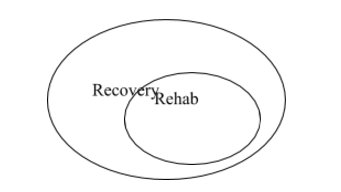
Stroke rehab is just one part of stroke recovery, but far too often stroke survivors equate the two. This is an error that therapists should discourage.
How does this common mistake occur? It has to do with the predictable post-stroke “arc of recovery.” During the subacute phase — defined as the first three to six months after stroke — there’s a period of natural recovery. Natural recovery — also known as spontaneous recovery — is recovery that comes directly from the healing of the brain. Although the subacute phase is generally considered a bad time for the stroke survivor (because they just had a stroke), it is a good time to recover.
How Natural Recovery Works
After a stroke there is a portion of the brain that is alive, but it’s not working. This is the area that surrounds the area of infarction. The area that is infarcted is dead. It is not coming back. It cavitates and fills with cerebral spinal fluid. Even scientists that look at stem cell therapy post stroke do not look at the area of infarction. It is dead and gone forever.
However, the area that surrounds the area of infarction is still alive, but just barely. During the subacute phase, this area heals and natural or spontaneous recovery begins. Clinicians (and survivors) should be wary about patting themselves on the back too much for recovery during the subacute phase. Every bit of research is clear about this: stroke survivors who get rehab do better than stroke survivors who don’t get rehab. Beyond that, pretty much any rehab will take advantage of spontaneous recovery.
But what happens after the subacute phase? The chronic phase is the recovery plateau. The fundamental flaw in managed care is that discharge from therapy is required upon the recovery plateau. That is, once natural recovery has ended (which is the definition of the plateau), stroke survivors are necessarily discharged. Rehab takes advantage of spontaneous recovery, but managed care requires that the stroke survivor do any additional recovery on their own.
Stroke Recovery Doesn’t Stop When Stroke Rehab Ends
So what is the message to the stroke survivor? It’s pretty clear: stroke rehab equals stroke recovery. It makes sense to the survivor because they recovered when they were in rehab, and they stopped recovering when they were discharged from rehab. What they are not told, and what clinicians should be clear about, is that recovery can happen long after rehab has ended. It is harder, yes, but it’s just as important to reaching the highest level of potential recovery.
This means that the discharge from stroke rehabilitation is extraordinarily important. Why? Because recovery continues even after rehab has ended. There is tons of clinical research that says exactly that: stroke survivors can continue to recover years after rehabilitation has ended. Clinicians should be clear that although the stroke survivor is being discharged, recovery continues. Conditions can help by putting in a robust home exercise program that promotes recovery in a stepwise fashion.
In much the same way an athlete or musician would take baby steps towards better performance, so can a stroke survivor take baby steps towards very important movement and functional changes
___________________________________________
Whether you are a caregiver, occupational therapist or even a stroke survivor yourself, Saebo provides stroke survivors young or old access to transformative and life changing products. We pride ourselves on providing affordable, easily accessible, and cutting-edge solutions to people suffering from impaired mobility and function. We have several products to help with the stroke recovery and rehabilitation process. From the SaeboFlex, which allows clients to incorporate their hand functionally in therapy or at home, to the SaeboMAS, an unweighting device used to assist the arm during daily living tasks and exercise training, we are commitment to helping create innovative products for stroke recovery. Check out all of our product offerings or let us help you find which product is right for you.