

Stroke Recovery Timeline: How Long Does It Take to Recover?
If you’re eager to understand more about your potential stroke recovery timeline, there are two factors worth digging into: the size and location of the stroke.
Regarding size, if a stroke is mild, the brain damage may be minimal and, as a result, recovery often occurs faster. When a stroke is considered massive (often measured by a high score on the NIH Stroke Scale), recovery may take longer and require intensive work.
Regarding location, a stroke can affect many different areas of the brain. This complicates recovery outlook because different areas of the brain control different functions. Therefore, depending on the area of the brain that was damaged, the secondary effects will vary.
For instance, a stroke in the left hemisphere may impair language (because the language center is located in the left hemisphere in most individuals). But an individual with a right hemisphere stroke may have completely different secondary effects.
As you can imagine, the differences in the size and location of a stroke have profound implications on every individual’s stroke recovery timeline. Additionally, your age and overall health prior to the stroke can affect the recovery timeline. Generally speaking, the younger you are and the healthier and more active you were prior to your stroke, the faster your recovery will be.
As you proceed with recovery and rehabilitation, it can help to understand what to expect (generally speaking) and what milestones may occur. We will discuss this next.
Stroke Recovery Timeline Milestones
It’s worth repeating that stroke recovery timelines look different for everyone.
For instance, even when two individuals experience strokes in the same area of the brain, recovery time can still vary. One left hemisphere stroke survivor may struggle with not being able to speak at all, while another may struggle only with word retrieval. Recovery time will vary greatly between such different impairments.
With that said, it can be helpful to understand some stroke recovery timeline patterns. That way, you know what to expect on the road to recovery.
Day 1: The Stroke Is Treated

A stroke is a medical emergency. As time goes on without intervention, more brain cells are deprived of oxygen-rich blood, which leads to brain damage. Swift treatment is necessary to stop the stroke and save the person’s life.
Initially, it’s likely that you will be admitted to an emergency department to stabilize your condition. Once the type of stroke (ischemic vs. hemorrhagic) is identified, treatment can be administered. This may include clot-dissolving drugs or surgery.
Once the stroke has been treated, rehabilitation begins immediately. This typically means starting rehab right from the hospital bed. Rehabilitation starts quickly to take advantage of the brain’s heightened state of neuroplasticity, as well as to minimize the muscle atrophy that is common from being in the hospital.
Neuroplasticity refers to the brain’s ability to rewire itself. This mechanism allows healthy parts of the brain to take over the functions damaged after a stroke. Recovery after stroke revolves around this process.
In the early stages of recovery, neuroplasticity is amplified by the phenomenon of spontaneous recovery. This refers to improvements that occur suddenly, often during the early stages of recovery when the brain is rapidly trying to heal from injury.
Week 1-3: Discharge from the Hospital
Depending on the severity of your stroke and how many medical complications occur, you will likely be in the acute care hospital for anywhere from 1-3 weeks. During your time in the hospital, you will work with a robust team of experts that will assess your condition and any secondary effects that you may have sustained, such as physical or cognitive impairments.
Your medical team will pay close attention to whether or not you can take care of yourself independently and if you are sufficient with the activities of daily living (such as using the toilet, dressing, and walking short distances).
Before you leave the hospital, your rehab team will help create a rehabilitation plan for you, which will include suggestions for the next step in rehabilitation.
Based on your abilities, you might continue rehabilitation at the following locations after discharge from the hospital:
- Inpatient rehabilitation facility: If you can benefit from (and tolerate) participating in 3 hours of therapy per day, you may continue recovery at an inpatient rehabilitation unit. To be accepted into one of these facilities, you need to have significant functional deficits, but also show potential for improvement and have assistance at discharge should you need it.
- Subacute rehabilitation facility: If you require a lower level of therapy with 1-2 hours of therapy daily, you may continue recovery at a subacute rehab facility. This would include something like a skilled nursing facility.
- Outpatient therapy: After discharge from the hospital or rehab facility, many patients continue with therapy by visiting a clinic as needed.
1-3 Months: Notable Recovery Should Occur

During the first 3 months of stroke recovery, you should see notable improvements in your progress. The brain is still in a state of heightened plasticity, which means that rehabilitation has a bigger effect during this time. Spontaneous recovery is also still possible during this early window.
After the first 3 months in your stroke recovery timeline, results often slow down and result in a plateau. At this point, most survivors are back at home continuing recovery both on their own and in outpatient therapy.
Fortunately, even though the plateau may slow things down, it does not mean that recovery is over. In fact, recovery can continue for many years as long as the survivor continues with rehabilitation.
Survivors should continue with physical therapy, occupational therapy, and speech therapy for as long as necessary to regain lost skills.
It’s also important to stay active at home between outpatient therapy sessions. This will provide the brain with the consistent stimulation needed to rewire itself.
Home therapy programs such as Flint Rehab’s FitMi are designed to help with this. When survivors use the home exercise system on a regular basis, they often see rapid results because the brain has the stimulation it needs to heal.
6 Months: Gait Improves in Most Stroke Survivors
I am text block. Click edit button to change this text. Lorem ipsum dolor sit amet, consectetur adipiscing elit. Ut elit tellus, luctus nec ullamcorper mattis, pulvinar dapibus leo.
As your stroke recovery timeline progresses, you will hit your own milestones in your own time.
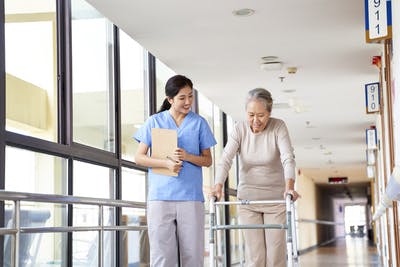
One popular milestone many survivors look forward to is regaining the ability to walk (if your walking was impaired by the stroke). Fortunately, if you participate in regular rehabilitation, the outlook is positive by the 6 month mark.
Studies show that about 65-85% of stroke patients will learn to walk independently after 6 months of rehabilitation. For those recovering from a massive stroke with severe effects, recovery may take more time.
It’s important to note that, at this point, spontaneous recovery has likely ended. In order to see results like this, it’s imperative to participate in a regular rehabilitation program to keep recovery going.
Fortunately, functional recovery is possible for a lifetime. As long as the person continues with rehabilitation, recovery can continue as well.
2 Years: Recovery Looks Increasingly Different for Everyone
At the 2 year mark, it’s impossible to say where any single survivor will be on their recovery journey. Some might have fully recovered function while others are still pursuing rehabilitation.
One comforting statistic is that, of the stroke survivors that could not walk without assistance at the 6 month mark, 74% should be able to walk by the 2 year mark. This is a great reason to keep participating in rehabilitation.
5 Years and Beyond: Functional Recovery Can Continue
As the years go by, recovery continues to look different for everyone. It all depends on your unique secondary effects and how consistently you participate in rehabilitation.
One study followed stroke survivors over 5 years and found that “the level of functional and motor performance at 5 years post stroke was equivalent to the level measured at 2 months.” While this might sound like bad news, there is an important lesson that you can take away from it.
Researchers credit the initial gains during the first 2 months of recovery to the intensity of inpatient rehabilitation. It’s likely that, after discharge from inpatient rehab, many survivors in that study stopped participating in rehab altogether.
Therefore, if you want to keep seeing results for the months and years after a stroke, you must continue with rehabilitation well after discharge from inpatient rehab. This is where home therapy programs can really help, especially since insurance will rarely cover formal therapies at a clinic this far out from the stroke.
See How Other Survivors Are Doing at Different Stages
It’s worth repeating that every stroke is different and therefore every recovery is different. Where one survivor is at the 5-year mark will differ greatly from others.
Still, it can be motivating to see how others are doing at different moments in their own unique stroke recovery timelines.
Below are some great examples of survivors pushing for recovery years after stroke. These are videos from our very own FitMi home therapy users, who submitted videos to help others see how much they have progressed:
Anthony: 1 Year Post-Stroke
Meet Anthony, who sustained left-side paralysis (hemiplegia) after his stroke. He started using FitMi as his home exercise program after 3 months, and has continued to improve. He still struggles with hand mobility, which can often take longer to recover than the arm or leg. Nevertheless, hand function can continue to improve with consistent rehabilitation.
Mary: 2 Years Post-Stroke
Meet Mary, a stroke survivor that was in a coma for 5 weeks after her stroke. She is an example of outstanding recovery, even when a situation may seem grim in the early stages.
Mary sustained right-side paralysis (hemiplegia) and participated in inpatient rehab for another 5 weeks. After two years, she felt like she reached a plateau, but broke through it by pursuing a consistent home exercise program.
Carol: 3.5 Years Post-Stroke
Meet Carolyn, a stroke survivor that overcame right-side paralysis. After discharge from inpatient rehabilitation, she used FitMi home therapy to keep improving at home. Now she is able to drive, ride her bike, and travel with confidence.
Becky: 11 Years Post-Stroke
Meet Becky, a brain stem stroke survivor that is going on 11 years of recovery. Brain stem strokes can lead to a condition called locked-in syndrome where the person becomes effectively paralyzed except for the eyes. Becky has come a long way to overcome paralysis and regain mobility. She is living proof of what’s possible.
Stroke Recovery Takes Time
We hope this article has provided the insight and hope you need to keep recovery going.
Your unique stroke recovery timeline will be influenced by some factors that you cannot control, such as your age and the size and location of your stroke. However, there are many factors that you can control, like how often you participate in rehab at home.
Ultimately, the most progress occurs for survivors that believe in themselves and pursue rehabilitation on a consistent basis. Your brain needs your help to rewire itself and regain lost abilities.
Best of luck on the road to recovery.
Keep It Going: Download Our Stroke Recovery Ebook for Free

Get our free stroke recovery ebook by signing up below! It contains 15 tips every stroke survivor and caregiver must know. You’ll also receive our weekly Monday newsletter that contains 5 articles on stroke recovery. We will never sell your email address, and we never spam. That we promise.