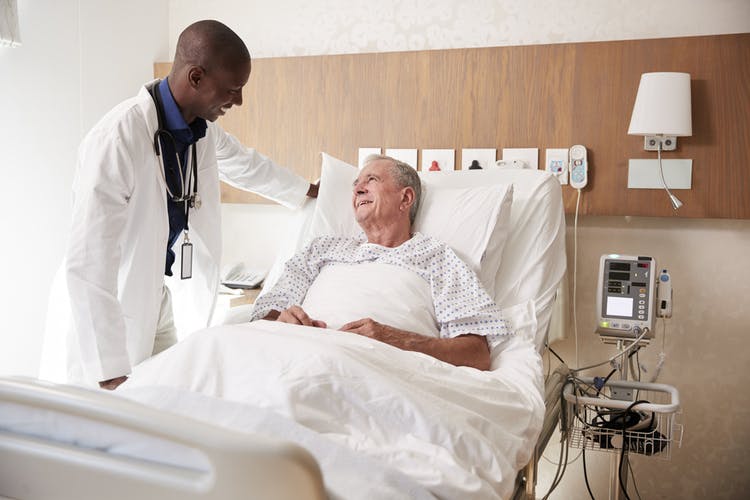
If your loved one is bedridden after stroke, there are steps you can take to help manage potential complications and maximize chances of recovery. Range-of-motion exercise are a staple of recovery, and you’ll soon learn why and how.
Why do some stroke survivors become bedbound?
Patients may become bedbound due to various complications after stroke, but most often the culprit is partial or total paralysis. Paralysis can occur after a stroke has damaged the areas of the brain responsible for movement.
The brain and muscles are constantly communicating with each other to create movement. When this communication is disrupted by a stroke, it can result in motor difficulties that make it difficult to sit, stand, or walk – resulting in a patient becoming bedbound.
When a survivor becomes bedbound after a stroke, it’s important to help them move and stretch their muscles otherwise other complications can occur.
What happens when you’re bedridden after stroke?
Before we dig into the steps you can take to help a loved one that is bedbound, let’s discuss what complications can happen.
Here are some common complications that can occur when someone is bedbound:
- Muscle atrophy. This occurs when your muscles waste away due to physical inactivity from being bedridden. It’s the opposite of what happens when you lift heavy weights and your muscles become bigger. Research has shown that individuals tend to lose approximately 50% of their muscle strength following just 3-5 weeks of bedrest. Furthermore, it takes a significantly longer amount of time to regain that strength after losing it.
- Learned nonuse. If a stroke survivor neglects their affected limbs for an extended period of time, it can lead to learned nonuse. When learned nonuse occurs, the brain completely forgets how to use the neglected area of the body. This is where the saying “use it or lose it” comes from.
- Contractures. This occurs when the muscles, joints, or connective tissues become extremely stiff and limit your range of motion. It happens when spasticity (muscle stiffness after stroke) is left unmanaged and progressively worsens.
- Pressure sores. Remaining in one position for too long can put pressure on the skin that touches the bed, causing tissue to breakdown and result in a pressure sore. This is especially common when sensation loss is involved.
- Respiratory problems. Fluid can build up in the lungs when the muscles aren’t working to remove excess fluid. This can lead to respiratory problems like pneumonia or atelectasis (the complete or partial collapse of all or part of the lung).
- Blood circulation problems and clotting. When the body remains in an idle, horizontal position for long periods of time, blood moves more slowly. This can increase the chances of blood clots forming in the legs (called a deep vein thrombosis, or DVT) and traveling elsewhere in the body and clogging an artery. (In the lungs, this would be a pulmonary embolism. In the brain, this would be an ischemic stroke.)
All of these complications have something in common: they can be improved through movement.
How can you promote motor recovery in bedbound survivors?
Movement is the key to maintaining the wellbeing of a bedbound stroke survivor. But not just any movement — strategic, passive exercises are the most helpful, at least until you are strong enough to perform more active exercises.
Passive exercise involves assisting your affected side through range of motion drills. Ideally, you would use your non-affected side to accomplish this. However, most bedridden stroke survivors cannot achieve this type of movement yet, so you will likely need the help of a therapist.
If you are a caregiver, you can ask your loved one’s therapist to show you how to do these passive exercises. That way, you can help your loved one perform the movements when the therapist is not around.
Movement not only helps improve potential complications such as learned nonuse, but it also maximizes chances of motor recovery.
Can bedridden stroke survivors regain the ability to move?
Perhaps the most inspiring benefit of passive exercise is that it may help restore movement in the paralyzed limbs.
When you move your body through passive exercises, you help stimulate the brain. This activates a process called neuroplasticity, where your brain adapts its neural circuitry to the tasks that you regularly perform.
Neuroplasticity is at the core of stroke recovery. When a stroke damages parts of the brain and results in a loss of function, neuroplasticity allows new areas of the brain to take on those functions. This is why consistent exercise is key to recovery — including recovery from severe motor disorders such as post-stroke paralysis.
Even if a caregiver is making the movements for you, it still helps activate neuroplasticity. And in time, passive exercise may help restore movement. The key is to pay attention to the movement. Studies have shown that this helps activate neuroplasticity and facilitate motor recovery even more.
Studies have also shown that mental practice (visualizing yourself doing the exercises in your head) activates neuroplasticity too. It’s particularly effective when combined with physical practice.
Mental practice is an accessible form of therapy for all bedbound stroke survivors, and it should not be overlooked due its simple nature. The effects can be powerful when done consistently. Try to encourage your loved one to mentally practice their exercises before you help them with passive exercise to see the best results.
If this all sounds like wishful thinking, be sure to read about Ron, a stroke survivor that recovered from paralysis by doing highly repetitive exercises on a consistent basis.
What is the life expectancy for bedridden stroke patients?
Due to the uncertain outcomes of stroke, many people find themselves wondering what the life expectancy is for bedridden survivors.
One study on the long-term outlook of stroke found that bedridden patients lived for about 4-6 more months after their stroke. However, the study only included individuals who were over 80 years old, and did not take into account other risk factors, such as pre-stroke disability or other vascular risk factors. Therefore, while being bedridden is a predictor of mortality, there are many other factors to consider on a case-by-case basis.
It’s important to know that every stroke is different and therefore every recovery is different. No one can say with certainty how long any given person has to live — and just the same: no one can say with certainty if a person can or can’t recover. The best results are seen when patients are motivated to improve and diligently pursue recovery long-term.
Ultimately, the outcome of any given stroke is unknown; and while this can be uncomfortable for family members of bedbound survivors, it also holds room for hope.
Take stroke survivor Becky, for example. After her stroke, she was bedridden due to locked-in syndrome: a condition where she could not move anything but her eyes.