
Zao Rehab
  • Home
  • Brands
    • Flint Rehab
    • Foot Scientific
    • Saebo
    • Innovaid
    • Neuroelectrics
    • Microbecare
  • Resources
    • Flint Rehab
    • Foot Scientific
    • Saebo
    • Innovaid
    • Neuroelectrics
    • Microbecare
  • Shop
  • Contact
Search
Zao Rehab

CALL US NOW

  • (65) 69376833
  • or
  • (65) 86067510
flint-rehab-logo
START HERE
  • FITMI
    • FitMi for Home
    • Clinic FitMi
  • MUSICGLOVE
    • MusicGlove for Home
    • Clinic MusicGlove
AFO BUNDLES
  • BLOG
    • Stroke Blog
    • TBI Blog
    • SCI Blog
    • CP Blog
    • Free Ebook
  • ABOUT
    • About
    • Support
  • Start here
  • FitMi
    • FitMi for Home
    • Clinic FitMi
  • MusicGlove
    • MusicGlove for Home
    • Clinic MusicGlove
  • AFO
  • Bundles
  • Blog
    • Stroke Blog
    • TBI Blog
    • SCI Blog
    • CP Blog
    • Free Ebook
  • About
    • About
    • Support

Flying After Stroke: How Long to Wait + Tips for Safe Travel

shop-mgr2023-01-17T12:24:00+08:00

How long after a stroke can you fly? What medical conditions make flying unsafe?

What’s the risk of having another stroke on the plane, and what happens in the worst-case scenario?

These are all pressing questions for anyone looking to fly after stroke.

To prepare you for safe travel, you’re about to learn the general guidelines for flying after stroke.

Guidelines for Flying After Stroke

The Stroke Association suggests that it’s best to wait at least two weeks to fly after stroke. If any new post-stroke conditions occur within the first two weeks, you want to have medical attention available.

Every stroke is different, though, so everyone needs to wait a different amount of time before it’s safe to fly. Ask your doctor how long you should wait until you can fly again after stroke.

It’s also important to consider the risk of having another stroke on board the plane.

Stroke patients have a 20% risk of having another stroke within the first month. To avoid having a stroke while on a plane, away from emergency treatment, it’s often a good idea to wait one month to be cautious.

Generally speaking, your medical team will clear you for flight if your medical conditions are stable. Otherwise, it’s best to remain on land where emergency medical attention is quickly and easily accessible.

Don’t gamble with your life. If your travel plans are flexible, it’s best to wait.

Risks to Consider Before Flying After Stroke

By understanding the risks of flying after stroke, you can have an informed discussion with your doctor on when it’s safe to fly again. Here are some complications that make flying after stroke risky:

Hypercoagulability (excessive blood clotting)

Hypercoagulability increases the risk of excessive blood clotting. As a result, this increases the risk of ischemic stroke, when an artery in the brain becomes clogged by a blood clot.

Furthermore, when you sit for excessive periods of time on a plane, you increase the risk of deep vein thrombosis, where a blood clot forms in the leg, which may break loose and clog an artery in the lungs (a life-threatening condition called pulmonary embolism).

Less oxygen for the brain

The air pressure is lower on a plane, which means there is less oxygen to fuel your body, including the brain. During stroke recovery, oxygen is critical for recovery (see: oxygen therapy for stroke) so it’s best to avoid sitting in an environment with less oxygen for prolonged periods of time.

Risk of recurrent stroke

There is a 20% risk of having another stroke within the first month after stroke. If someone has a stroke on a plane, the pilot will attempt to make an emergency landing to get you the emergency medical attention you need.

Although lives have been saved by emergency landings before, it still prolongs the time before you receive treatment, which is why many doctors suggest waiting before you fly after stroke.

Now that you understand the risks of flying, let’s discuss how to make your trip as safe as possible if you decide to fly after stroke.

Tips for Flying After Stroke
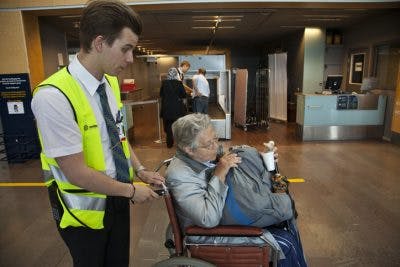
If you have been cleared to fly after stroke, here are some tips to improve your safety and wellbeing:

  • Wear compression socks if you have hypercoagulability. It helps your veins and leg muscles move blood more efficiently.
  • Walk around when the fasten seatbelt light is off. Movement helps prevent blood clotting issues like deep vein thrombosis. If you cannot walk around for an extended period due to turbulence or other reasons, at least do some leg exercises while seated (march in place, bend knees, pump ankles, etc.)
  • Keep medication in your carry-on bag and be sure not to accidentally leave it in your checked bag.
  • Carry medical documentation and declare medication upon arrival in a new country. Some countries may confiscate undeclared medication, so don’t let that happen to you.
  • Contact the airline to arrange special assistance if you need vision assistance, hearing assistance, wheelchair service, mobility and medical devices, etc.
  • Get travel insurance because medical care abroad can be extremely expensive.
  • Travel during normal hours so that you don’t get stressed by waking up too late. High blood pressure is a stroke risk factor that you want to avoid!
  • Give yourself an extra hour to get through security and walk to your terminal.
  • Travel with a companion if possible so that someone can assist you if necessary.

Overall, it’s up to your doctor to decide if and when its safe for you to fly after stroke. Everyone has different risk factors and medical complications that require more or less waiting to fly after stroke.

If your doctor clears you to fly, we hope these tips help you have a safe flight.

Keep It Going: Download Our Stroke Recovery Ebook for Free

Get our free stroke recovery ebook by signing up below! It contains 15 tips every stroke survivor and caregiver must know. You’ll also receive our weekly Monday newsletter that contains 5 articles on stroke recovery. We will never sell your email address, and we never spam. That we promise.

I want this!

Share this post

Facebook Twitter LinkedIn Google + Email

Recent Posts

Types of Spinal Cord Injury: Complete vs Incomplete, Levels, & ASIA Scale
T6 Spinal Cord Injury: 7 Major Secondary Effects
What to Expect After a T4 Spinal Cord Injury: Is Recovery Possible?
Mild Cerebral Palsy: How to Identify the Signs & Why Early Intervention Matters
Severe Cerebral Palsy: What to Expect and How to Manage
Understanding Ataxic Cerebral Palsy: How to Spot the Symptoms & Treatment Methods

Zao Inc Pte Ltd

37, Jln Pemimpin, #06-02 Mapex, Singapore 577177

contactus@zaoinc.com

(65) 69376833

(65) 86067510

Zao Malaysia Sdn Bhd

B-01-11, Gateway Kiaramas Corporate Suites No 1, Jalan Desa Kiara, Mont Kiara 50480, Kuala Lumpur, Malaysia

contactus@zaoinc.com

(60) 1168688828

(60) 108946135

Follow Us

Zao International (HK) Limited

Flat/RM A, 3/F, Cheong Sun Tower, 116-118 Wing Lok Street, Sheung Wan, Hong Kong

contactus@zaoinc.com

(852) 91880612

Brands

  • FlintRehab
  • FootScientific
  • Saebo
  • Innovaid
  • Neuroelectrics
  • Microbecare

© 2024 Zao Inc Pte Ltd. All Rights Reserved.

  • Home
  • Brands
    • Flint Rehab
    • Foot Scientific
    • Saebo
    • Innovaid
    • Neuroelectrics
    • Microbecare
  • Resources
    • Flint Rehab
    • Foot Scientific
    • Saebo
    • Innovaid
    • Neuroelectrics
    • Microbecare
  • Shop
  • Contact