
Zao Rehab
  • Home
  • Brands
    • Flint Rehab
    • Foot Scientific
    • Saebo
    • Innovaid
    • Neuroelectrics
    • Microbecare
  • Resources
    • Flint Rehab
    • Foot Scientific
    • Saebo
    • Innovaid
    • Neuroelectrics
    • Microbecare
  • Shop
  • Contact
Search
Zao Rehab

CALL US NOW

  • (65) 69376833
  • or
  • (65) 86067510
flint-rehab-logo
START HERE
  • FITMI
    • FitMi for Home
    • Clinic FitMi
  • MUSICGLOVE
    • MusicGlove for Home
    • Clinic MusicGlove
AFO BUNDLES
  • BLOG
    • Stroke Blog
    • TBI Blog
    • SCI Blog
    • CP Blog
    • Free Ebook
  • ABOUT
    • About
    • Support
  • Start here
  • FitMi
    • FitMi for Home
    • Clinic FitMi
  • MusicGlove
    • MusicGlove for Home
    • Clinic MusicGlove
  • AFO
  • Bundles
  • Blog
    • Stroke Blog
    • TBI Blog
    • SCI Blog
    • CP Blog
    • Free Ebook
  • About
    • About
    • Support

Compensatory Strategies for Stroke Patients: Are They Stepping Stones Toward Recovery?
shop-mgr2023-01-17T16:07:52+08:00

Compensatory strategies are similar to “shortcuts” for patients with range of motion, strength, or coordination problems after stroke.

If a stroke survivor eats with her left hand, when normally she holds a utensil with her right hand, she is using a compensation strategy to finish a meal.

Sometimes compensation is necessary for carrying out the activities of daily living and ensuring safety. But many patients reach a “tipping point” where compensation gets in the way of recovery.

You’re about to learn when it’s appropriate to use compensation techniques, and when you should challenge yourself to stop.

This will help you get as close to a full recovery from stroke as possible.

What Counts as Compensatory Strategies for Stroke Patients

Compensation involves accomplishing a task in a different way than before injury. A common compensatory strategy seen in patients after stroke is leaning the torso forward to reach an object  instead of fully extending the affected arm.

Recovery, on the other hand, involves accomplishing a task the same way you did before injury. This involves working hard during rehabilitation so that you can use your affected arm to reach for an object like normal.

It’s important to note that compensatory strategies are not bad. They are helpful and necessary sometimes.

But there often comes a “tipping point” where patients can accomplish tasks without them. Over-reliance on compensatory strategies after this tipping point gets in the way of stroke recovery.

To prevent this from happening, you need to first understand spasticity and synergy patterns.

When Spasticity and Synergistic Movement Get in the Way

Many stroke patients struggle with “normal movement” after stroke because of spasticity and synergy patterns.

Spasticity involves stiffness of the affected muscles. If there is spasticity in your arm or hand, It can be difficult to open your palm or reach for an object on a shelf.

Synergy patterns disrupt “normal movement” by causing muscles in your arms or legs to misfire with purposeful and non-purposeful movement. This can cause the shoulder to hike when you try to move your affected arm forward, for example. Synergy patterns can also occur during non-purposeful movement, like sneezing.

Patients should view these “problems” as signs of recovery from stroke, because they are!

The presence of spasticity means that the patient is not paralyzed. And the onset of synergy patterns means that movement is returning to the body.

Spasticity and synergy patterns will diminish over time as long as the patient continues with physical therapy and rehabilitation. Mobility will improve as a result.

Then, somewhere along the way, you may outgrow the need for certain compensatory strategies. But when?

Persistence Is the Cure for Compensation Techniques After Stroke

Remember that compensatory strategies for stroke patients are helpful, but eventually get in the way of recovery.

To work past the need for compensation techniques, you need to constantly question your methods — preferably on a daily or weekly basis.

Each morning, or each Monday, ask yourself, “What am I doing differently than before, and where do I feel ready to challenge myself?”

Never give up compensatory strategies that are necessary for your safety, like using a cane or walker, without consulting your therapist. When you’re on your own, start small.

For example, if you noticed that you lean your torso forward when you reach for the table salt, see if you can sit back and extend your arm to get it.

And if you can’t do it today, try again next week. This is how you can prevent yourself from getting stuck in a rut and keep progressing.

Benefitting from the Slow Pace of Stroke Recovery
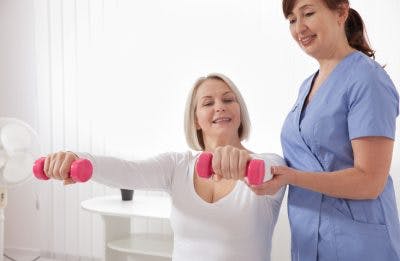
Aside from curiosity, recovery will also involve slowing down and doing things the “slow” or difficult way.

Choosing to slowly use your affected arm instead of leaning forward means you might take longer to accomplish certain tasks. Try to be patient when doing things without compensation techniques.

When you slow down and accomplish tasks normally (the way you did before injury), you are stimulating your brain. It doubles as therapy.

Stimulating your brain this way will help you strengthen the neural networks responsible for recovery. The more you practice, the better you’ll get thanks to neuroplasticity.

This is how you can improve your chances of a full recovery from stroke. Patients that accomplish a full recovery are constantly challenging themselves to do things the “hard way” – without compensatory strategies.

Although it’s more difficult, and perhaps more frustrating, it leads to more recovery in the long-run.

Maximizing Motor Recovery After Stroke

Compensatory strategies should not be viewed as bad. They are often helpful and necessary to get things done safely.

However, if patients become too reliant on these “shortcuts,” they may get stuck in a rut and stop progressing.

But if patients remain persistent and constantly challenge their compensation techniques, they’ll have the best chance at recovery.

Keep It Going: Download Our Stroke Recovery Ebook for Free

Get our free stroke recovery ebook by signing up below! It contains 15 tips every stroke survivor and caregiver must know. You’ll also receive our weekly Monday newsletter that contains 5 articles on stroke recovery. We will never sell your email address, and we never spam. That we promise.

I want this!

Share this post

Facebook Twitter LinkedIn Google + Email

Recent Posts

Types of Spinal Cord Injury: Complete vs Incomplete, Levels, & ASIA Scale
T6 Spinal Cord Injury: 7 Major Secondary Effects
What to Expect After a T4 Spinal Cord Injury: Is Recovery Possible?
Mild Cerebral Palsy: How to Identify the Signs & Why Early Intervention Matters
Severe Cerebral Palsy: What to Expect and How to Manage
Understanding Ataxic Cerebral Palsy: How to Spot the Symptoms & Treatment Methods

Zao Inc Pte Ltd

37, Jln Pemimpin, #06-02 Mapex, Singapore 577177

contactus@zaoinc.com

(65) 69376833

(65) 86067510

Zao Malaysia Sdn Bhd

B-01-11, Gateway Kiaramas Corporate Suites No 1, Jalan Desa Kiara, Mont Kiara 50480, Kuala Lumpur, Malaysia

contactus@zaoinc.com

(60) 1168688828

(60) 108946135

Follow Us

Zao International (HK) Limited

Flat/RM A, 3/F, Cheong Sun Tower, 116-118 Wing Lok Street, Sheung Wan, Hong Kong

contactus@zaoinc.com

(852) 91880612

Brands

  • FlintRehab
  • FootScientific
  • Saebo
  • Innovaid
  • Neuroelectrics
  • Microbecare

© 2024 Zao Inc Pte Ltd. All Rights Reserved.

  • Home
  • Brands
    • Flint Rehab
    • Foot Scientific
    • Saebo
    • Innovaid
    • Neuroelectrics
    • Microbecare
  • Resources
    • Flint Rehab
    • Foot Scientific
    • Saebo
    • Innovaid
    • Neuroelectrics
    • Microbecare
  • Shop
  • Contact