


Helpful Hand Exercises for Stroke Patients of All Ability Levels

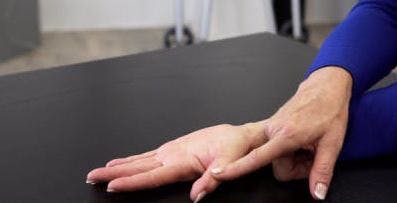
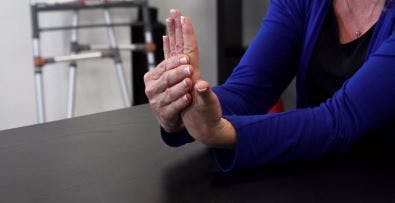
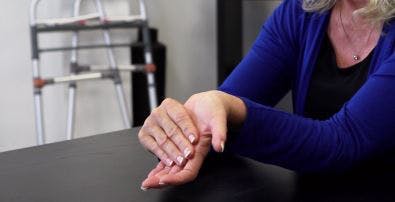
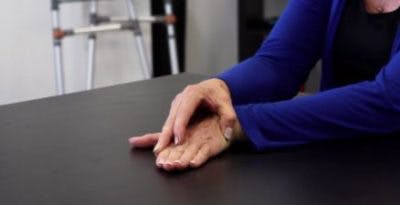
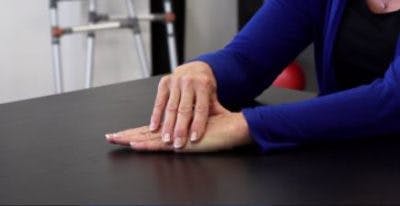
This side-to-side wrist movement is called ulnar deviation (towards the pinky) and radial deviation (towards the thumb). It’s not a common movement done in isolation, but is critical for getting your wrist/hand into the right positions for a variety of tasks like grasping, lifting, and writing. This is the last level 1 hand exercise for stroke patients.
Place your affected hand on the table with your palm down. Then, use your non-affected hand to slide your hand to the left, then to the right. Repeat slowly side to side like a windshield wiper 20 times.
Level 2: Moderate Hand Exercises for Stroke Patients
The following hand exercises for stroke patients are appropriate for people with some hand mobility, but may have some spasticity or weakness still.
The key to effectively regaining movement in your hand is to practice these stroke hand exercises regularly. If necessary, you may still use your non-affected hand for assistance, but make sure you are helping only enough to complete the movement.
Here are the Level 2 therapeutic hand exercises for stroke patients:
4. Rolling Movement

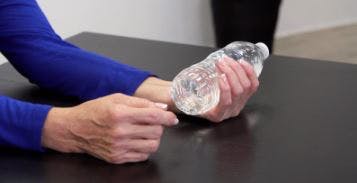
For this slightly advanced hand exercise, place a water bottle in your affected hand. Keep your hand and fingers relaxed.
Curl your fingers as you grasp the water bottle in your hand. Then slowly release back down. Repeat the movement by continuing to open and close your fingers slowly around the bottle so your brain has time to recognize and retrain the motion. Perform 10 to 15 repetitions.
This hand exercise is a great way to isolate and strengthen the wrist and finger flexor muscles in the hand to improve grasp.
5. Wrist Curl
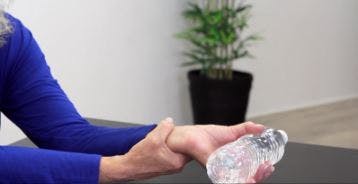
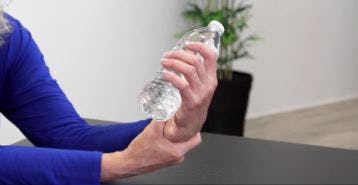
This stroke hand exercise is like a bicep curl, but for your wrist, and is helpful for improving grip function. Hold the water bottle in your affected hand and use your non-affected hand to support your arm.
Allow your wrist to stretch down, and then curl your wrist up. Repeat up and down slowly for 10 to 15 repetitions. You should feel the muscles in your forearm working.
6. Grip and Release
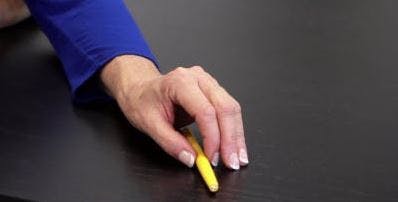
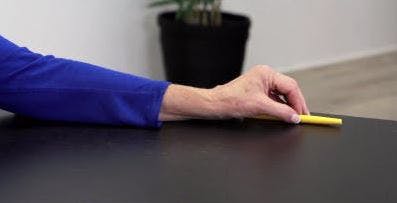
This is the last Level 2 hand exercise for stroke patients and is great for developing more fine motor control.
Place a pen on one side of the table. Grip it as best you can with your affected fingers, especially between the thumb and index finger. Slide the pen across the table, and then release.
Focus on gripping the pen gently. To emphasize the therapeutic quality of this exercise, use the least amount of force necessary to move the pen.
Repeat by sliding the pen back and forth across the table, keeping your forearm on the table. This helps to isolate the wrist and hand while preventing compensation with the shoulder to complete the movement (known as synergistic movement).
Only perform the exercises that are challenging, not frustrating. If you are unable to do it at first, then use a little help with your non-affected hand, or do some mental practice and try again in a few weeks.
Level 3: Challenging Hand Exercises for Stroke Patients
The following hand exercises for stroke patients are intended for those with some normal hand movement and dexterity, but want to further improve fine motor control.
7. Pen Spin
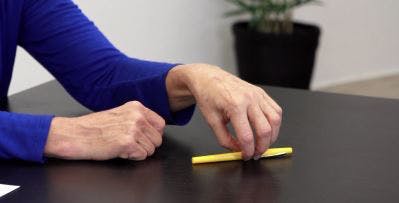
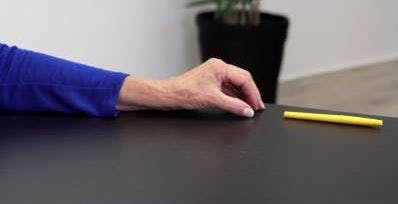
For this advanced hand exercise, place the pen on the table and use your thumb and fingers to spin it. Stabilize your elbow on the table to prevent the use of your shoulder during this movement. Focus on isolating your thumb, index, and middle fingers.
Challenge yourself with speed during this exercise. Spin the pen quickly for 15 seconds, then try to spin it in the opposite direction.
8. Coin Drop


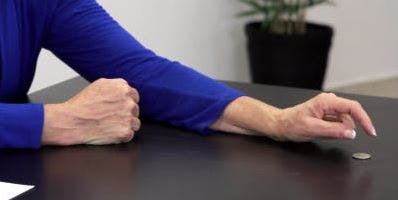
This advanced hand exercise is comprised of 3 movements. Start by placing 8 quarters in a row in the palm of your affected hand. Use your thumb to move one quarter to grip with your index finger and thumb.
Then, place the quarter onto the table while keeping the other quarters in your hand using your other fingers. This is called in hand manipulation and translation skills. This is a complex hand exercise because it requires coordination of all 5 fingers.
After you finish placing them down individually, reverse the exercise to pick them back up. You can increase the challenge and also make this a cognitive training exercise by using different size coins (ie. nickels, dimes, quarters) and adding up the amount as you place them on the table in a random order.
9. Water Cup Pours
This stroke hand exercise works on hand and wrist control in a functional way. Take two cups (use plastic instead of glass for safety) with one filled with water. Holding a cup in each hand, slowly pour the water from one cup to the other without spilling.
By alternating the pour between hands, you will work on coordination when pouring as well as stabilization when holding and receiving the water. You can mix it up and work on different grasp types by using regular cups of different sizes or mugs/pitchers with handles.
10. Finger Opposition
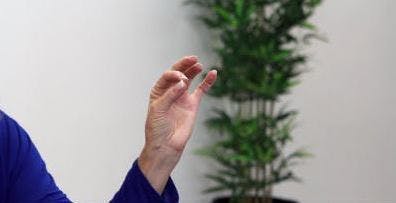

For this last hand exercise for stroke patients, try to touch each fingertip to your thumb. Pinch and release starting with your index finger, moving to your middle finger, then ring finger, and finally your little finger. Between each finger tap, fully extend and stretch your fingers so that you’re also working the extensor muscles.
This is the same movement as MusicGlove hand therapy, which is a rehab tool that helps you exercise and achieve high repetition while playing along to a musical game. It’s a fun way to do your own home rehabilitation and is clinically proven to help improve hand function in stroke patients in as little as 2 weeks.
Getting Started with Hand Exercises for Stroke Survivors
By performing these hand exercises for stroke patients on a daily basis, you will be able to improve your hand mobility and function. Try not to be discouraged if recovery happens slowly, because hand mobility takes time and consistency to improve.
If you want to give yourself an extra boost, download our free ebook below. It contains a whopping 25 pages of illustrated hand exercises that you can follow along to at home.
Keep it Going: Get a Free Rehab Exercise Ebook (25 page PDF)

Get our free ebook filled with 25 pages of rehab exercises featuring photos of licensed therapists. Sign up below to get your copy!
When you sign up, you’ll also receive our popular Monday newsletter that contains 5 articles on stroke recovery.
We never sell your email address, and we never spam. That we promise.