


Gait Training Exercises for Stroke Patients: How to Improve Your Walk

For this gait training exercise, start in a standing position. Then, lift your leg out to your side about 45 degrees (or as far as you can). Hold it there for a few seconds and then bring your foot back down. The key is keep your core stable and not lean your trunk. The only thing that should be moving is your leg. Do 15 repetitions, then switch sides.
In our video below, watch Liliana, DPT, demonstrate more leg exercises that you can add to your gait training program.
Now let’s move onto some balance and core exercises that can help improve your gait.
Balance and Core Exercises for Gait Training
Gait training involves more than just your legs. Walking is a full-body activity, which means that your gait training exercise program should target the full-body as well. Up next, you’ll discover some balance and core training exercises that will help improve your gait and ability to walk.
5. Toe Taps
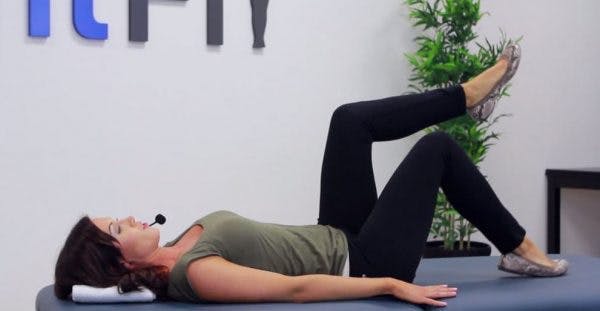
This gait training exercise targets all the muscles in your core. Lay on your back with both legs bent up at a 90 degree angle. Try flattening your lower back against the ground by engaging your abdominals. Make sure you’re still able to breathe! Your shins should be parallel to the floor and your core should be fully engaged.
From there, slowly lower to tap your left foot on the floor and bring it back up to the starting position. Repeat on the other leg and alternate between each leg for a total of 20 repetitions, focusing on keeping your spine flat and neutral on the ground throughout the exercise.
6. Knee to Chest
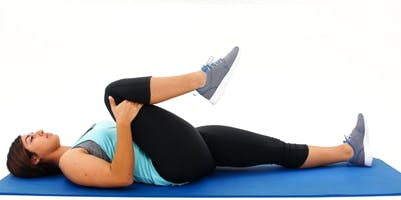
For this gait training exercise, start from a comfortable lying position. Pull one knee up and hug it into your chest while the other leg stays straight resting on the floor. Hold for 3 to 5 seconds, then alternate legs for a total of 10 repetitions.
Try not to use your leg muscles to achieve this movement. Focus specifically on engaging and tightening your core.
Watch Cassie, DPT, demonstrate more core exercises for stroke patients in this video:
Now let’s move onto some foot exercises that can help improve your gait and stability while you walk.
7. Ankle Dorsiflexion
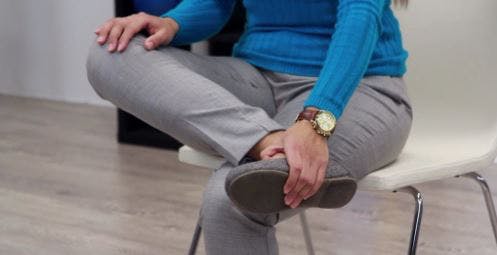
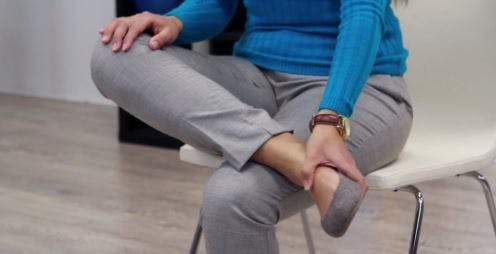
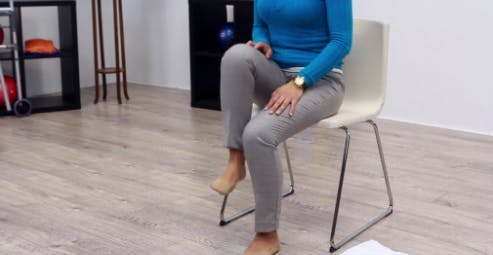
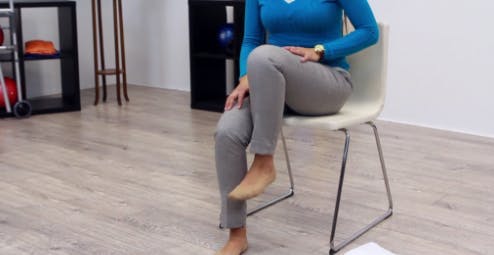
This gait training exercise will help target your feet and improve conditions like foot drop after stroke. To begin, start from a seated position and cross your affected leg over you other leg. Then, move your foot into dorsiflexion (image 1) by using your unaffected hand to move your foot up towards your knee. Next, move into plantar flexion (image 2) by extending your foot back down.
For added challenge, complete these exercise without the use of your hand. (That would turn this into an active exercise instead of a passive exercise.) Aim for a total of 20 repetitions
8. Assisted Toe Raises
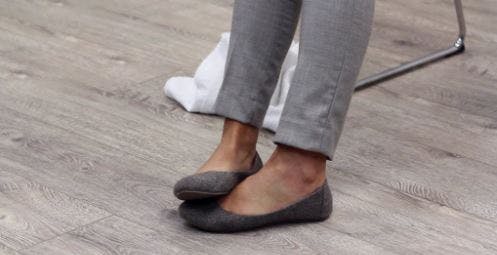
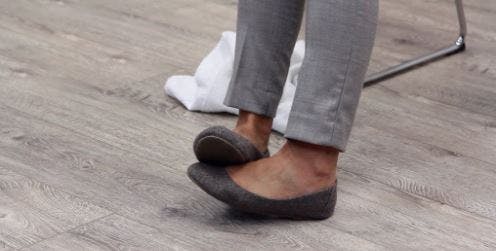
This gait training exercise can be difficult if you have foot drop. However, it can help improve foot drop by retraining the brain to send the correct signals to your foot.
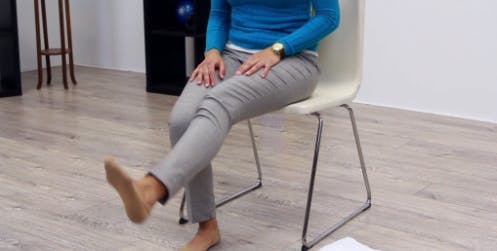
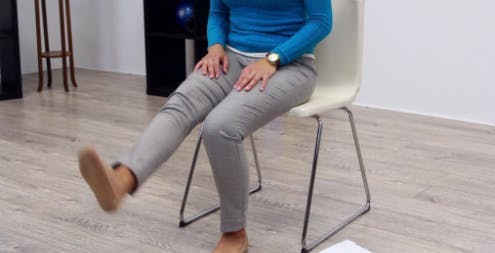
Start from a seated position. Then place your unaffected foot underneath your affected foot. Then, use your foot to assist your affected foot up. Then release back down. Once you regain the ability to perform these without assistance, do active exercise for added challenge. Perform a total of 15 repetitions.
9. Heel Raises
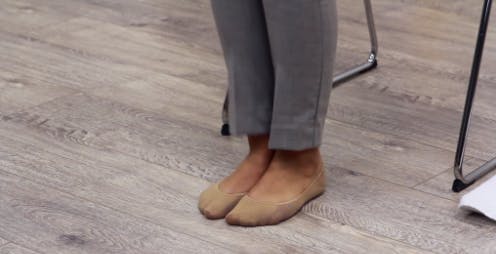
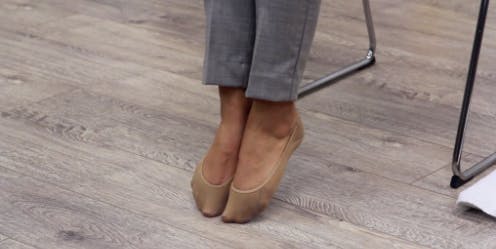
This is an advanced gait training exercise. Start seated with your feet flat on the ground. Then, point your toes and lift your heels off the ground. Then place your feet back down flat on the floor and repeat. You should feel this in your calf muscles.
Increase the challenge by doing this same exercise in standing. Do 15 repetitions, making sure to keep your weight equal through both feet.
While this concludes our list of gait training exercises, your recovery doesn’t have to stop here! There are plenty of other ways to boost your results and get back on your feet faster.
Other Rehabilitation Methods to Supplement Gait Training Exercises
Gait training exercises are just one way to improve your gait and walking abilities after a stroke. There are many other rehabilitation methods available that you can add to your regimen to help boost recovery even more.
Here are other excellent gait rehabilitation methods that your therapist may recommend:
Strength Training
Some muscle atrophy is common after a stroke. Therefore, adding some strength training can help improve your lean muscle mass and strength, which is necessary for gait. Without the appropriate strength, your muscles may have difficulty performing necessary actions while walking like your quadriceps stabilizing your knee or your calf muscles to push off each stride.
Balance and Core Training
Balance and core training both help improve gait. Walking is a full-body task that requires coordinated movement from the feet, legs, and core. With balance and core training, you can improve your stability while walking and reduce your falls risk. This is especially important when walking on uneven surfaces you might encounter in the park, crosswalks, and dirt trails.
Functional Electrical Stimulation
Adding electrical stimulation to the affected muscles during gait training exercises can help boost results, according to studies. Be sure to work with a physical therapist to learn where to place the electrode pads and the appropriate device settings as it will differ for everyone.
High-Tech Home Exercise Equipment
Improving your ability to walk requires a high repetition of gait training exercises. More repetition helps stimulate the brain and boosts neuroplasticity. High-tech exercise equipment like Flint Rehab’s FitMi can help. Many patients have gotten back to walking and driving (i.e. targeting the gas pedal) by using FitMi consistently.
Walking Itself
Another way of increasing neuroplasticity is working on movements and activities that are specific to your goals. So one of the best methods to improve your walking is by directly practicing walking. Many rehabilitation facilities have bodyweight support systems that you can use for gait training on a treadmill.
However, on your own, you can start with a short distance, like 1 block, and gradually increase how far you walk each week. Even if you have weakness or spasticity, focus on making your gait as smooth, symmetrical, and natural as you possibly can. Every step is a rep, and repetition matters!
By combining the gait training exercises covered in this article with some of the other methods described above, you will be able to take a comprehensive approach to improving your gait. As always, be sure to consult with your physical or occupation therapist first before making changes to your rehabilitation program.
Getting Started with Walking Exercises for Stroke Patients
Gait training exercises can improve your strength, mobility, balance, and coordination, which can all help prevent falling after stroke. Ultimately, a consistent rehab exercise program can help you get you back onto your feet and back to the activities that you enjoy.
Focus on high repetition of exercises to help rewire the brain. Be sure to target your core along with your legs to improve overall coordination and balance. You can add booster techniques, like electrical stimulation and FitMi home therapy, for even faster results. By using these methods, you can improve your walking ability and reclaim your independence after stroke.
Keep it Going: Get a Free Rehab Exercise Ebook (25 page PDF)

Get our free ebook filled with 25 pages of rehab exercises featuring photos of licensed therapists. Sign up below to get your copy!
When you sign up, you’ll also receive our popular Monday newsletter that contains 5 articles on stroke recovery.
We never sell your email address, and we never spam. That we promise.