

Balance Exercises for Stroke Patients: How to Improve Stability
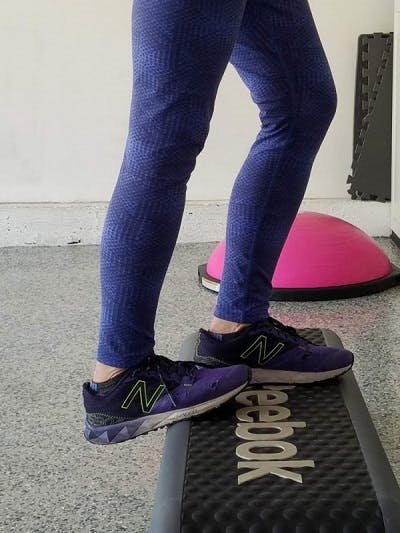
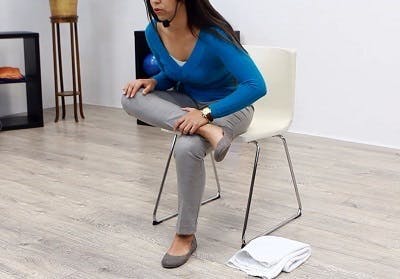
This stretch can be beneficial as a warm-up exercise before attempting to practice balance exercises after a stroke.
Start by sitting near the edge of your seat. Then, cross one ankle over your opposite knee. Gently lean forward until you feel a stretch in the hip and buttock area. The more you lean forward, the more you’ll feel the stretch in your hip. Hold for 15-20 seconds, then repeat for the other side.
This stretch can increase hip range of motion which is necessary for many balance exercises, as well as functional tasks like putting on pants and shoes.
Isometric Back Extensor Holds
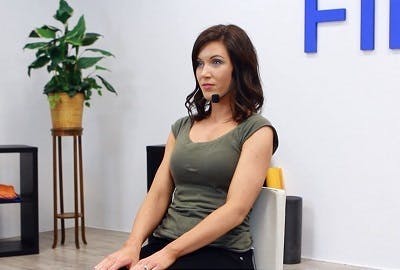
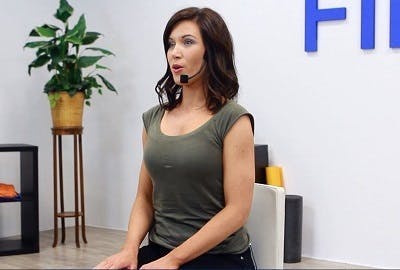
This balance exercise is ideal for patients following a stroke who are looking to target the core muscles. Sit on the edge of your seat, feet firm on the ground, and gently press your back against the chair. You should feel the muscles in your back contracting.
Hold for a few seconds and then bring your body back to an upright position. Make sure that your back is straight as you come back up. Repeat 10 times.
Lateral Trunk Flexion


Post-stroke weakness can cause core and upper body stiffness. This balance exercise can improve posture which can contribute to your balance while sitting or standing. At the same time, you’re also working your oblique abdominal muscles that help with trunk control.
While seated, tilt your right shoulder down towards your right hip. You can also use your hand to reach down the side of the chair. Hold for 5 seconds. Then, return to midline and repeat on the other side. Alternate sides for a total of 10 repetitions.
Hip Abduction Side Kicks
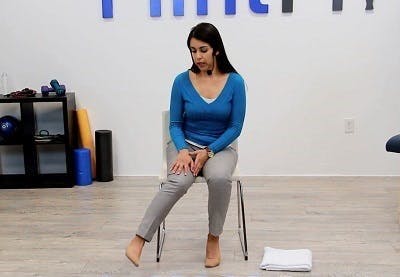
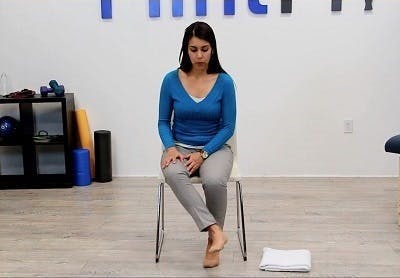
This simple balance exercise focuses on side-to-side movements, which can help improve range of motion and hip strength for patients after a stroke.
First, sit with your legs shoulder-width apart. Then, slightly raise your affected foot off the ground. You’ll almost immediately start to feel the pressure it places on your core and leg.
Kick your leg out to the side and then bring it back inwards. Challenge yourself during this balance exercise by keeping your trunk totally still while you’re moving your leg. Repeat 20 times.
Balance Exercises that Target “Stability Limits”
Your limits of stability refers to how comfortable you are able to challenge or distribute your center of mass around your base of support. In other words, this is how far and how well you can move your body before you lose your balance. Try these balance exercises to specifically work on improving your limits of stability.
Trunk Circles
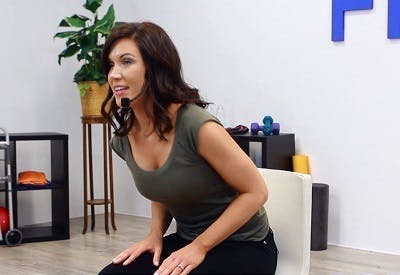
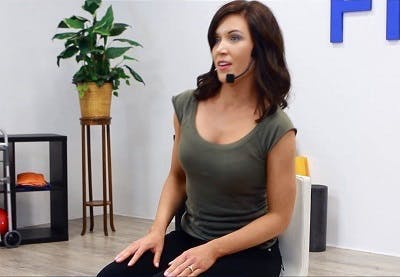
Trunk circles encourage you to engage various muscles in your upper body without moving your lower body, which makes it a great exercise for improving balance after stroke.
While seated, move your torso clockwise in circular motions. Focus on engaging your core muscles and feel free to use your hands for additional support. Start with small circles, then gradually making the circles bigger and bigger to challenge your balance.
Repeat 10 times and then change directions (counterclockwise).
Forward Punches


If you have enough core strength to sit upright without using your arms, try this balance exercise! While seated, spread your arms out in front of you and clasp your hands together. Gently, lean forward as far as you comfortably can and use your back muscles to return to an upright position. Repeat 10 times.
To make this exercise more challenging, reach down towards the floor. Also, try leaning diagonally or to the sides to target different directions and trunk muscles.
Balance Exercises for Stroke Patients that Target “Anticipatory Postural Adjustments”
Anticipatory postural adjustments refer to unconscious muscle activation and weight shifts that occur just before moving your body. These micro-adjustments are supposed to happen automatically and keeps us from over- or under-shooting a movement, but they may become impaired after a stroke. Thankfully, anticipatory postural adjustments can be retrained with some of these balance exercises for stroke patients.
Sit-to-Stands
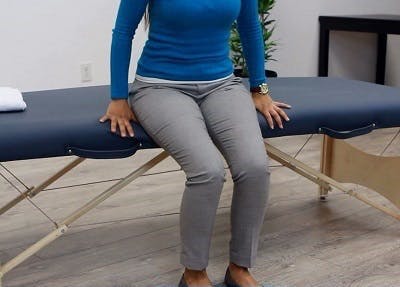
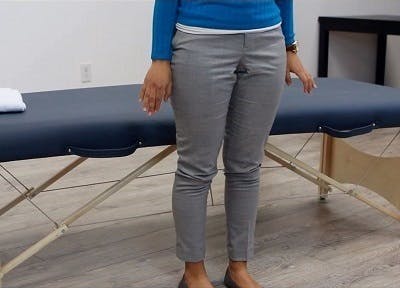
This exercise will help you develop both sitting and standing balance after stroke. Sit towards the front edge of your seat with your legs shoulder-width apart, and make sure that your feet are positioned slightly behind the knees.
Slowly transition into a standing position by leaning your body forward and pushing through your legs. You may use your hands for additional support as needed. Stand up tall and hold your balance for a few seconds, and then slowly lean your trunk forward again, bending at the waist, to sit back down. Throughout the whole movement, try to keep equal weight through both feet on the ground. Repeat 10 times.
To make it more challenging, do it without hand support or add resistance by holding something heavy in your hands.
Seated/Standing Marching
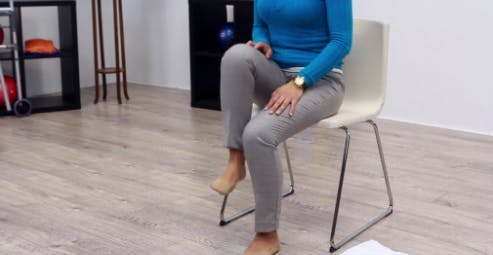
Alternating seated marching is an excellent balance exercise to regain coordination after a stroke and is a transferrable skill when relearning how to walk again. As you lift each leg, your body constantly shifts your center of gravity to balance out movements in your lower body.
Start by sitting tall on the edge of your seat. Then, alternate lifting your knees as high as you can. Engage your core to keep your trunk from leaning. Practice for 3 rounds of 30 seconds. For the best results, focus on your posture rather than speed.
Heel and Toe Raises

Coordination in your lower body is critical for improving your balance after stroke, and this balance exercise will help you to learn how to shift your weight forward and back on your feet.
Stand with your feet about hip-width apart while using a chair or countertop to maintain your balance. Slowly push up onto your toes to lift your heels off the ground. Then lean back on your heels as you lift your toes up. Notice how when your lower body leans back, you have to counter-balance by shifting your upper body forward.
Hold for a few seconds and then repeat 20 times.
Single Leg Stance
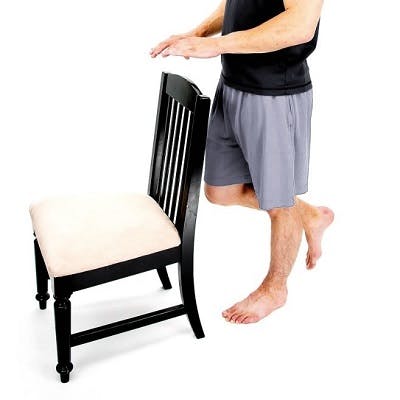
For this balance exercise, stand and use a chair to help keep you balanced. Lift one leg and try to hold for at least 15 seconds. Once you find your center of gravity, try to balance without leaning on the chair.
If you have limited mobility, avoid doing this exercise until you are ready; and be sure to have a caregiver present if you decide to give it a try. Safety first.
Balance Exercises that Target “Sensory Orientation”
Sensory orientation refers to the use of our vision, proprioception (position sense in space), somatosensory system (what you feel), and our vestibular system (inner ear organ that coordinates what our eyes and head sense during movement) to maintain our balance and equilibrium. These balance exercises are some examples to improve sensory orientation.
Standing Balance with Eyes Closed
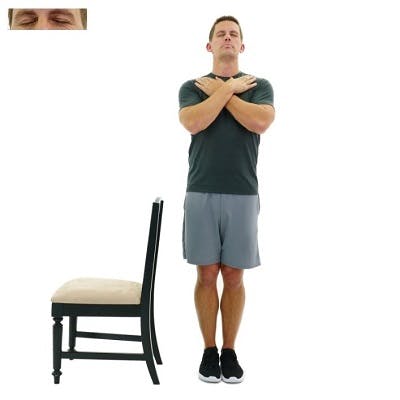
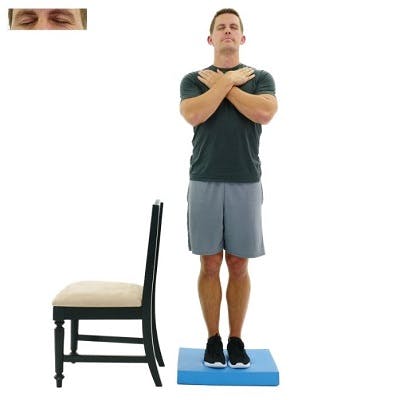
First, make sure that you’re next to a wall or chair for safety in case you lose your balance. Stand with your feet touching one another and your arms crossed. Then, close your eyes and try to maintain your balance for 20 to 30 seconds.
To make this exercise more challenging, stand on an unstable surface like a thick pillow or foam pad. Again, make sure you’re next to a chair or wall for safety, and only do this exercise if you can first perform it with eyes open easily.
Standing Balance with Head Turns
This balance exercise targets your vestibular system. Stand next to a wall or chair with your feet together. With your eyes open and focused on a fixed target in front of you, slowly turn your head side to side while keeping your balance. Perform 20 total head turns. Start off slow, and increase the speed or amount of the head turns as you get better.
Improve “Stability in Gait” with These Balance Exercises for Stroke Patients
If you feel unsteady while walking, you may have issues with gait stability. These problems might come up when you try to walk faster, change directions, turn, or are on uneven ground. The following balance exercises specifically work on improving your balance while walking.
Wide-Based Gait Training
Wide-based gait training is the perfect balance exercise for patients who want to improve their walking ability after a stroke. Stand with your legs spaced apart. A wider stance creates a more stable base to balance on. Practice walking with this stance until comfortable. Then, gradually narrow the distance between your legs. This is a great way to improve your gait without mobility aids.
Tightrope Walk
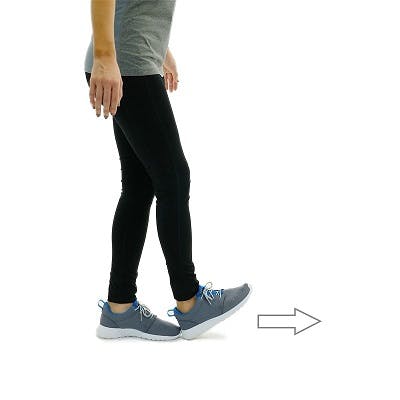
This balance exercise for stroke survivors will develop control as you walk along a narrow path.
Position yourself along the hallway so that you’re near the wall for safety. Start by standing with one foot directly in front of the other, touching your heel of one foot to the toes of the other foot. Remember to hold onto the wall for stability if needed. Take slow steady steps with your heel touching your toes with each step as though you’re walking along a tightrope.
Try to keep your eyes facing ahead rather than down on the ground. You can focus your eyes on a fixed target to help maintain your equilibrium.
Side Stepping
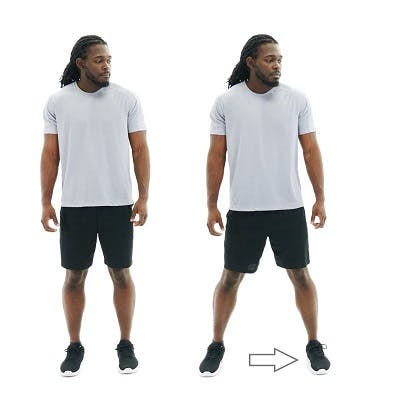
Having the ability to walk sideways is important when navigating tight spaces such as in the bathroom, restaurant, or theater. For this balance exercise, take steps to the side, making sure to lift your foot up each time. Maintain a tall posture while keeping your hips facing forward the entire time (ie. Don’t rotate). Take 20 steps to the left, then 20 steps to the right.
Walking with Head Turns
When walking out in the world, it’s rare that we walk with our head fixed straight ahead at all times. It’s important to be able to walk while moving your head so that you can look around you or talk with the person next to you without losing your balance.
For this balance exercise, make sure there is a clear path in front of you free from obstacles or clutter. Start walking forward while slowly turning your head side to side, trying your best to stay on a straight path. As you improve, you can make this balance exercise more challenging by walking faster or moving your head quicker. You can also nod your head up and down too to mix things up.
Recovering Balance After Stroke
Poor balance can increase your risk of falling and make activities like getting out of bed or walking extremely difficult. Therefore, it’s essential to practice balance boosting exercises to maximize your quality of life and prevent falls after a stroke.
Don’t worry if you can’t perform some of these balance exercises right away. Balance takes time to develop, so focus on what you can do and make adjustments that work for you.
By choosing balance exercises that target your specific areas of impairment, and with consistent practice, you can stimulate the neurological changes necessary to recover balance after stroke.
Keep it Going: Get a Free Rehab Exercise Ebook (25 page PDF)

Get our free ebook filled with 25 pages of rehab exercises featuring photos of licensed therapists. Sign up below to get your copy!
When you sign up, you’ll also receive our popular Monday newsletter that contains 5 articles on stroke recovery.
We never sell your email address, and we never spam. That we promise.