See how a post-rehabilitation exercise specialist named Margaret helped her husband recover from hand paralysis after stroke.
His therapist said that he would never move his hand again – but Margaret proved the therapist wrong.
See the exact steps she took for his hand paralysis treatment below. We hope it inspires your recovery.
Recovering from Hand Paralysis
Margaret never knew that her career as a post-rehabilitation exercise specialist would help her personal life one day.
But after a massive stroke left her husband with hemiparesis, including hand paralysis, she quickly got to work.
The prognosis for stroke patients with paralysis is not always good. In fact, Margaret’s husband was told that there was no hope to regain hand movement.
Margaret, however, refused to accept that her husband couldn’t recover.
She researched hand recovery options and purchased Flint Rehab’s MusicGlove for therapy at home.
Then she used MusicGlove to help him regain hand function by combining it with mirror therapy – with a twist.
We illustrate her method step by step below.
How to Treat Hand Paralysis Margaret’s Way
Please note that these steps are anecdotal and based on someone’s personal experience. However, we included links to clinical studies that support the basic principles of this hand recovery method.
Here’s what Margaret did to help her husband regain use of his paralyzed hand:
1. Start by Understanding Mirror Therapy
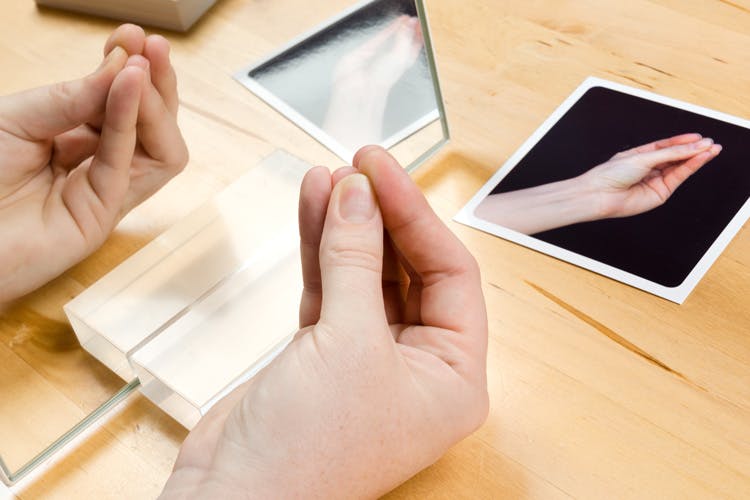
Typically, mirror therapy involves using a tabletop mirror to reflect your ‘good’ hand in place of your affected hand. (See the photo at the top of this post.)
This creates the illusion that both hands are moving and tricks your brain into thinking that your affected hand is working properly.
Although you logically know it’s just a reflection, this still helps activate neuronal processes and begins rewiring the brain through the process of neuroplasticity.
2. Use Mirror Therapy Differently
Margaret used the principles of mirror therapy for this hand paralysis treatment, but she ditched the mirror.
Instead, she placed the MusicGlove on her husband’s ‘good hand’ and had him exercise with MusicGlove normally. Meanwhile, she would assist his affected hand to mirror his movements.
She wouldn’t move his hand to the game; she moved his hand to exactly match what his other hand was doing. So if he missed a note, she missed a note.
This mirroring and passive movement helped her husband’s brain rewire itself.
Because of this unique therapy, he went from being completely flaccid to having twitches! Although this might seem like a small achievement to some, any survivor struggling with paralysis knows what a significant and noteworthy sign of recovery this is.
3. Try Different Exercises
You can try these methods with any hand therapy exercise you like. All that matters is that you’re being consistent and exercising daily.
Consistency is important for activating neuroplasticity and encouraging the brain to rewire itself. Anything you can do to encourage consistency will help, such as fun-to-use hand therapy devices like MusicGlove.
4. Be Repetitive About It
Margaret’s husband saw remarkable results with MusicGlove because the device utilizes a high number of repetitions. In fact, the average user achieves hundreds of repetitions per session.
In order to efficiently rewire the brain, you need high repetition because that’s how the brain rewires itself. Each time you repeat a movement, the connections in the brain become stronger.
If you aren’t consistent, then the connections quickly grow weaker and fail to produce results.
5. Don’t Get Discouraged
Your results may come slowly at first — almost painstakingly so. Try to be as patient as you can with yourself. After all, you’re rewiring your brain. It’s a complex process that involves time and hard work.
Trust the process and know that although results aren’t showing immediately, your brain is hard at work trying to make something happen.
Signs of Recovery from Hand Paralysis
Every recovery is different, so everyone will see results at different speeds. Margaret’s husband was able to see twitches after just a few weeks of this hand paralysis treatment.
While twitches are small movements, they are a big deal for someone recovering from hand paralysis – especially after his therapist said it was impossible. This proves that, even when the prognosis is grim, there is always hope for recovery.