

Vestibular Therapy for Concussions: What Happens in the Inner Ear?
Communication is a complex function that involves various skills such as attention, comprehension, speech, memory, and more. When cognitive skills become affected by a brain injury, cognitive speech therapy can help survivors improve their communication and overall cognitive function.
This article will discuss the causes and symptoms of cognitive-communication disorders, as well as numerous cognitive speech therapy exercises you can try at home.
Causes of Cognitive-Communication Disorders
Many of the cortical (outer layer of the brain) and subcortical (deeper) structures of the brain responsible for cognitive processes can become damaged after a traumatic brain injury. This can result in a cognitive-communication disorder that causes symptoms such as difficulty paying attention during conversation, recalling information, or following instructions. Cognitive-communication disorders can occur individually or in combination with other language conditions such as aphasia, dysarthria, or apraxia of speech depending on the areas of the brain affected.
For example, damage to the Wernicke’s area can lead to fluent aphasia, a language disorder where a person can speak fluently, but their speech will not make sense. Individuals with this type of aphasia may use made-up words or simply connect words together in sentences that are nonsensical. Wernicke’s area is typically located in the left hemisphere of the brain, near the back of the temporal lobe. Injury to this region can affect an individual’s understanding of spoken and written language.
After a concussion, individuals may experience vestibular dysfunction, a disturbance in the balance system of the body. This can often lead to symptoms such as dizziness, nausea, or imbalance, just to name a few. Fortunately, these symptoms are usually not permanent and can be treated through vestibular therapy for concussions.
This article will discuss the causes of vestibular dysfunction, symptoms, and the most effective vestibular exercises for concussion.
What Is Vestibular Dysfunction?
Simply put, vestibular dysfunction is a “disturbance of the body’s balance system”, This balance system, called the vestibular system, is a sensory system that helps you create a sense of balance and orientation, which are both necessary for coordinating movement. A concussion, or mild traumatic brain injury, is one of the many causes of vestibular dysfunction.
The vestibular system can be broken into the peripheral and central vestibular systems. The peripheral vestibular system is made up of the inner ear and the eighth cranial nerve, which connects the inner ear to the brain. The central vestibular system, then, includes the parts of the brain involved in processing vestibular input.
Following a concussion, both peripheral and/or central vestibular dysfunction may occur. For example, a concussion may directly damage the brainstem, temporal lobe, and/or cerebellum, all of which are involved in processing vestibular input.
When a concussion disrupts any part of the vestibular system, the neural connections to and from the brain may also become damaged or destroyed. This makes it difficult for the brain to communicate with the vestibular system and recognize the position of the head in relation to the rest of your body and surroundings.
Due to the forces involved in head trauma, the organs within the inner ear may also become damaged, resulting in peripheral vestibular dysfunction. Fortunately, neural connections can be strengthened and rewired through neuroplasticity.
Neuroplasticity is the brain’s ability to rewire itself by strengthening existing neural pathways and creating new ones as needed. With neural pathways restored, the brain will be able to communicate better with the rest of the body and vestibular system, making it once again aware of space and its surrounding environment.
Anatomy of the Vestibular System
The body receives vestibular input through the vestibular labyrinth, found in the inner ear. This consists of two main parts: the semicircular canals and the otolith organs.
The semicircular canals are three fluid-filled tubes lined with tiny hairs that monitor head motion. Due to inertia, movement of the head causes the fluid within the semicircular canals to shift. This causes the hairs to move, which communicate with the brain in order to detect motion. Each canal detects a specific direction of movement, with one focusing on up-and-down movement while the other focuses on tilting left or right. The third canal focuses on rotational movement.
While the otolith organs (the utricle and saccule) have similar functions to the canals, they respond more to gravitational force. The calcium carbonate crystals inside these organs detect when the body is in motion, such as when one is moving up in an elevator.
After vestibular information is received, it is transmitted through the eighth cranial nerve to the brain, where it can be further processed.
Symptoms of Vestibular Dysfunction Post-Concussion
Studies estimate roughly 30% of concussion survivors experience persistent symptoms that can last months or years after the injury. Symptoms may linger after the initial impact and can include a variety of different vestibular function issues including:
- Dizziness
- Imbalance
- Eye strain or blurred vision
- Disorientation
- Nausea or vomiting
- Vertigo (sudden spinning sensation)
- Nystagmus (rapid and uncontrollable eye movement)
- Spatial impairment (awareness of your body in relation to space)
- Motion sickness or sensitivity
- Unsteady gait (abnormal walking)
- Postural instability
Symptoms for peripheral and central vestibular dysfunction can sometimes overlap. Therefore, obtaining a proper diagnosis is essential to differentiate between the two. Though symptoms may vary for every survivor, most can benefit from vestibular therapy for concussions.
Evaluation for Inner Ear Concussion Treatment

- Since symptoms of vestibular dysfunction often vary, there is no one test consistently used to assess vestibular dysfunction. A doctor or physical therapist may perform both vision and balance tests, among others. Medical history, a general physical, and cognitive exams are also necessary in order to provide an adequate diagnosis.During an evaluation, your doctor may ask you to:
- Focus your vision on a single point
- Move your head side-to-side and up-and-down
- Move your head diagonally while they look for irregular eye movements
Doctors will also search for any ocular or vision problems that may cause further issues. It is important to keep in mind that vision not only involves visual acuity, but also other factors such as eye tracking, ease of focus, and peripheral vision. For example, survivors with visual impairment may have clear 20/20 vision when standing or sitting still. However, movement may cause their vision to blur. Therefore, a comprehensive eye assessment including head movement is necessary when diagnosing vestibular dysfunction following concussion.
It is important to note that vision changes may not be present initially after injury, and can be masked behind symptoms such as eye straining, fatigue, and headaches. Therefore, a full evaluation and assessment is imperative to ensure all symptoms are accounted for. With a proper diagnosis, vestibular therapy can begin.
Vestibular Therapy Exercises for Concussions

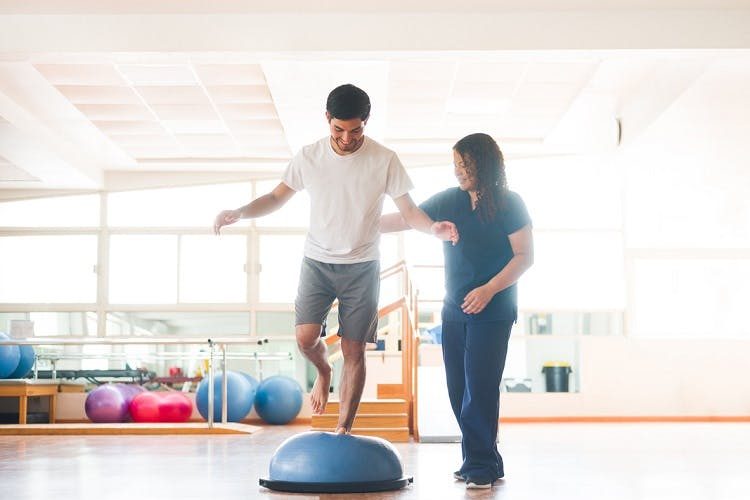
To address your specific needs, your therapist will likely create a customized and evidence-based vestibular therapy plan. A vestibular therapy session will usually include much more complex vestibular physical therapy exercises than simply standing on a balance board. You must engage your peripheral and central vestibular systems, as well as your visual system for optimal recovery. This often involves moving your head around, requiring your eye gaze to also shift appropriately, in order to maximize vestibular therapy and improve function.
Here are a few rehabilitation methods commonly used in vestibular therapy for concussions:
Gaze Stabilization
The vestibulo-ocular reflex allows you to stay focused on an object even when your head is moving. After a concussion, this reflex can become damaged, causing disorientation and vertigo. Eye exercises can help improve gaze stabilization and restore the vestibulo-ocular reflex after a concussion.
Eye exercises can include a variety of exercises such as the one below:
- While sitting upright in a chair, draw an X in the center of a piece of paper.
- Hold the paper in your hand at arm’s length, keeping it at eye level.
- Focus your gaze on the X and turning your head side to side. If this is doable, try moving as fast as you can without the X becoming blurry.
The level of difficulty can be increased or reduced depending on your comfort level. For instance, while the goal is to perform the exercise above for 1 minute, you should start with a shorter goal of a couple seconds and increase the time as you improve.
Habituation Exercises for Concussion
The second popular method used in vestibular therapy is habituation exercises. These exercises are particularly helpful for individuals who experience extreme dizziness when they move around. Habituation exercises help reduce dizziness by gradually increasing exposure to the movements that trigger them, such as bending over to pick something up off the ground.
A sample habituation exercise may include:
- Moving from a sitting position to lying flat on your back
- Standing up and sitting back down
- Sitting up and bending forward until your head is between your knees
The goal is to build up enough tolerance until those movements are no longer triggering or causing motion sickness. Your therapist will help ensure the exercise is both challenging and manageable to prevent overexertion.
Balance and Exertional Training
Another common method used in vestibular therapy for concussions is balance and exertional training. This type of training focuses on improving endurance, balance, and building up strength. Balance and exertional training is also particularly useful for athletes who sustained a concussion because it helps build up stamina and improve steadiness, while also improving cardiovascular levels.
Although balance and exertional training is usually done at a slow pace, based on your ability level, it’s important to treat other symptoms (such as dizziness) beforehand to prevent exhaustion or other complications. If you notice any vestibular symptoms flaring up while exercising, stop immediately or take a break. Your therapist can provide you with more guidance and ensure which vestibular physical therapy exercises for concussion are suitable and safe for you.
Epley Maneuver
Although only effective for a certain type of vestibular dysfunction, the Epley Maneuver can be life-changing for many concussion survivors. Benign paroxysmal positional vertigo (BPPV) is the most common type of long-lasting peripheral vestibular dysfunction following concussion, which occurs when the crystals in the otolith organs dislodge. Fortunately, the crystals can be pushed back into their proper place with the Epley Maneuver.
This method involves moving the head into four positions and remaining in each position for at least 30 seconds. It’s a relatively quick procedure that usually takes 5 minutes to complete and has a high success rate.
However, the Epley Maneuver must be performed by a specialist; do not try it on your own. If you are interested in the technique or want to learn more information, search through this list of certified vestibular specialists to find the right one for you.
Additional Rehabilitation Techniques
Other rehabilitation techniques that may also be utilized include:
- Controlled breathing: this can help reduce symptoms such as dizziness and nausea. While improper breathing may not be a vestibular issue, studies show breathing techniques are effective tools for vestibular rehabilitation after concussion.
- Substitution: when one sensory system is impaired, others can be trained to compensate for its lost functions. For example, if one’s vision has not been affected, survivors may be trained to rely more on their eyesight to make up for a lost sense of balance.
Nearly all survivors can benefit from vestibular therapy, but the outcome will depend on how dedicated you are to the rehabilitation process. The more you practice, the more neuroplasticity will be activated.
Participating in Vestibular Therapy After Concussion
Vestibular therapy is one of the most effective treatments for balance disorders after a concussion. However, not all dizziness is caused by inner ear issues. Some, for example, can be caused by cervical problems, such as whiplash. If that’s the case, vestibular therapy will not have any positive effects.
Survivors may experience a variety of vestibular symptoms after a concussion such as nausea, imbalance, and blurred vision. Consult with your doctor to obtain a proper assessment to identify all the vestibular symptoms. With a diagnosis, it is essential to start treatment using appropriate vestibular exercises for concussion in order to improve.
We hope this article helped you understand how vestibular therapy for concussions can help promote recovery.
Keep it going: Do you know these 15 essential TBI recovery tips?
If you like our content, you’ll love our ebook and newsletters! Get instant access to our TBI recovery tips ebook with 20 pages of helpful advice by signing up below.
You’ll also receive our emails that share survivor stories and more useful TBI recovery tips, which you can opt out of at any time. (We know you’ll love them, too.)
We will never sell your email address, and we never spam. That we promise.