

9 TBI Occupational Therapy Activities to Help You Regain Independence
These TBI occupational therapy activities will help improve your independence after brain injury.
All of these activities can be easily done at home, and are focused on improving fine motor skills, attention, and memory.
First, it’s important to understand why OT activities are important for recovery after traumatic brain injury.
The Importance of TBI Occupational Therapy Activities
TBI occupational therapy is all about retraining your brain to perform activities of daily living after brain injury. when we do things we have done before, it is easier for the brain and muscles to be activated.
Some examples of activities of daily living are dressing, bathing, cooking, and eating. After a TBI, these basic activities can be difficult to perform.
There are several reasons why a person cannot perform activities of daily living after a brain injury.
Either they have lost the physical strength to carry out these tasks, or they have difficulty with the cognitive abilities needed to perform them.
The good news is, the potential to regain these skills may be achieved by activating your brain’s neuroplasticity. As you practice an action, your brain forms new neural pathways in response. Repetition of that action reinforces those pathways, until the action becomes integrated into your brain and muscle function.
This is where occupational therapy activities come in. These exercises are designed to help you regain the physical or cognitive ability needed to perform certain activities of daily living.
The more you practice these activities, the easier they will become, and the more independence you will regain.
TBI Occupational Therapy Activities for Apraxia
The first group of TBI occupational therapy activities are focused on treating apraxia. This is a motor disorder that causes difficulty with motor planning.
TBI patients with apraxia often have trouble planning out the movements in the sequence needed to perform a task.
The following occupational therapy exercises can help improve motor planning and make activities of daily living go much smoother.
1. Maze Drawings

This activity is great for improving movement planning, attention and processing.
The goal is just to draw a line and find the way out of the maze.
You can find printable mazes, with varying levels of difficulties, online.
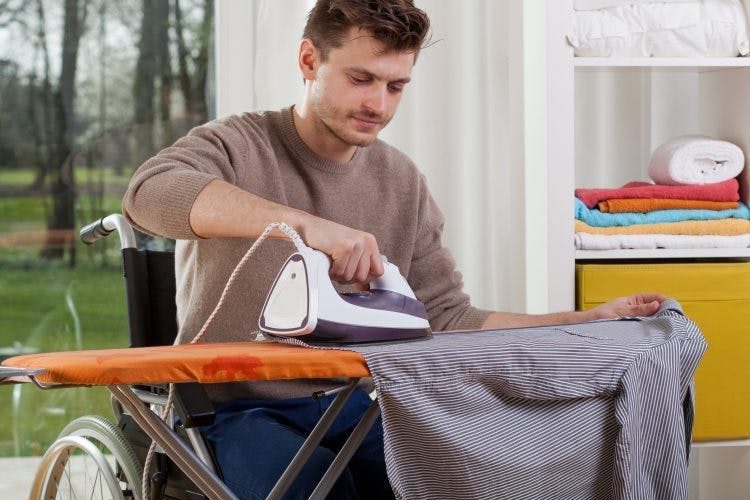
2. Dressing Yourself
This occupational therapy activity focuses on improving ideational praxis.
This fancy term refers to “the ability to manipulate objects in a sequence of actions involving knowledge of object function, knowledge of action and serial order.” To put this in simpler words, it’s how you know to use things like a microwave, for example.
The goal of the activity is to dress yourself appropriately. You’ll have to plan the parts of the body that each item of clothing goes on and the order that you put them on.
This activity will also improve your memory and planning skills.
3. Complete the Drawing
In this activity, one person will draw half of a symmetrical object, and you draw the other half.
This helps improve visual-spatial function, left/right discrimination, and how items are positioned in space.
TBI Occupational Therapy Activities for Fine Motor Skills
Fine motor skills refer to the ability to make intentional, directed movements with your hands, wrists, and fingers. They are crucial for regaining activities of daily living.
Below are a few occupational therapy activities that improve fine motor skills:
4. Board Games

Not all TBI occupational therapy activities have to feel like work.
If you want to improve your fine motor skills, one of the best ways to do that is to play games! When you join your mind and body in an activity, it decreases the overall internal stress and activates healing.
Board games like checkers, chess, and card games let you practice your fine motor skills, while also engaging cognitive skills like planning, decision making, scanning, and problem-solving.
Occupational therapy teaches people to balance out work, rest, and play.
5. Finger Curl
First, bring the tip of your index finger down to the tip of your thumb. Pinch and release.
Then do the same movement on all four fingers.
If this exercise gets tedious, Flint Rehab’s MusicGlove is a fun, effective alternative that improves fine motor skills in as little as two weeks.
6. Stacking Coins
For this activity, grab a handful of coins and scatter them all over a table.
Next, start stacking the coins on top of each other. Make sure you only stack pennies on top of pennies, dimes on top of dimes etc.
This will not only improve your fine motor skills, it will also improve your organization and categorization skills.
Occupational Therapy Cognitive Treatment Ideas
Memory plays an important part in activities of daily living.
Here are some TBI occupational therapy activities that will improve your memory skills.
7. Card Recall

For this activity, select four playing cards in sequence (3, 4, 5, and 6 of clubs) and place in random order face up. After five seconds turn the cards face down.
Next, turn the cards over in numerical sequence (3, 4, 5, 6).
As you improve, increase the number of cards in the sequence, allowing additional viewing time for each card added, to a maximum of 7 cards.
8. Sketch from Memory
First, look at a picture or a scene for one minute.
Now, turn around and try to draw the scene from memory. If drawing is too difficult, make a list of everything you can remember from the scene. (two dogs, a taxi, a bicycle, etc..)
Once you’re finished, compare what you’ve put down to the original and see how much you observed.
You can make this easier by starting with simple line drawings and working your way up to more complex pictures.
9. Cognitive Training Apps
Sometimes it can be difficult to incorporate these memory activities daily.
That’s where apps like the CT Speech and Cognitive Therapy App come in handy.
It contains thousands of exercises that can help you improve memory and concentration, skills that are crucial for relearning activities of daily living after brain injury.
Finally, it can also send you reminders on your phone. This means you’ll never accidentally forget to do your therapy again.
Traumatic Brain Injury Occupational Therapy Treatment Ideas
We hope these exercises help you stay active at home in between visits with your OT.
As long as you stay moving and keep your brain stimulated with therapeutic activities, you are on the road to recovery.
Keep it going: Do you know these 15 essential TBI recovery tips?
If you like our content, you’ll love our ebook and newsletters! Get instant access to our TBI recovery tips ebook with 20 pages of helpful advice by signing up below.
You’ll also receive our emails that share survivor stories and more useful TBI recovery tips, which you can opt out of at any time. (We know you’ll love them, too.)
We will never sell your email address, and we never spam. That we promise.