


7 Benefits of Art Therapy for Brain Injury Patients
There are many creative ways to treat the secondary effects of a traumatic brain injury (TBI). One effective method is through art therapy.
Art therapy for brain injury patients is a great method for improving important mental skills and can even soothe emotional distress.
If you want to learn more about this awesome therapy for TBI patients, keep reading!
Art Therapy for TBI Recovery
Art therapy for brain injury patients is a personalized therapy approach that helps strengthen cognitive function.
While art has helped people find peace and healing for millennia, it was only in the mid-twentieth century that art was accepted as a valid therapeutic approach to treating brain injury.
The great thing about art therapy is that it engages both the right and left hemispheres of the brain. In fact, in a recent MRI study, researchers found that art activates both parietal lobes, the part of the brain that controls your depth perception and reasoning.
This has huge implications for brain injury patients, since one of the main goals in TBI recovery is to stimulate the brain and activate neuroplasticity, the brain’s natural mechanism for healing itself.
The more you stimulate the brain, the more the brain forms neural pathways that repair the damage done to it. This means art can literally heal your brain.
Besides the fact that art therapy activates neuroplasticity, there are many other benefits that it offers for brain injury patients. We’ll look at those in the section below.
Benefits of Art Therapy for Brain Injury Patients
The following are some of the best reasons to try art therapy for brain injury.
1. Sharpen fine motor skills and visual perception
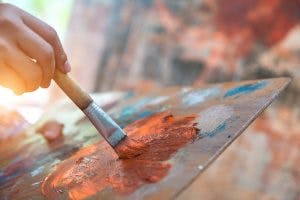
Handling paint on a paintbrush can help you gain more control of your fingers and hands, which can transfer to other skills in your life, such as eating.
Working on fine details while painting also improves your hand-eye coordination. Plus, painting helps you develop stronger perception skills, since you’ll need to learn how to make 2-D objects look three-dimensional.
2. Improve concentration and attention
Art therapy, whether it involves painting, drawing, or taking a pottery class, requires heavy concentration.
You not only need to concentrate on making a flower the right shape, but you also have to keep in mind where it belongs in relation to the rest of the painting.
This will help you improve your ability to focus for longer periods of time and teach you to keep more than one thing in your mind at once.
You might find this hard at first, but the more you practice, the easier it will become.
3. Boost problem-solving skills
Art might look easy, but it actually takes a lot of hard thinking.
Unless you’re a natural artist, your painting is not going to come out perfectly on the first try. This means you must know how to identify problems in your painting or drawing and find creative solutions.
Again, this won’t happen right away. You probably will get frustrated a lot in the beginning. But art therapy gives you a safe place to develop your problem-solving skills and learn how to work with disappointment.
4. Relieve symptoms of depression and build social skills

Art therapy is proven to help combat the chemical imbalances that cause depression.
Since depression is a major problem after brain injury, this is just one more reason why patients should give it a try.
Because it often takes place in groups, art therapy also gives brain injury survivors a chance to rebuild their social skills and form friendships, which is key to making a good recovery.
5. Improve self-management and self-esteem
One of the best reasons to try art therapy after brain injury is it gives you a space where for once, you are in control.
You get to decide what to create, and how to create it. This helps you practice decision making and gives you back some autonomy, which will also boost your self-esteem.
Do you want to paint a landscape with grass and trees and mountains? Go ahead! Do you want to just have fun and mix a bunch of colors together? You can do that too!
There are no wrong answers here; that’s the beauty of art.
6. Increase mental flexibility and perseverance
Painting almost never goes the way you planned. You might run out of the right color, you might have used the wrong brush, or drawn things too big. But if it doesn’t look right, you can’t just give up; you need to figure out what to fix.
Doing this often enough will help you develop more flexibility and creativity in the rest of your life as well. You’ll learn not to get too attached to things, since when you’re painting you always have to be prepared to wipe it out and start over.
In short, art therapy teaches you how to deal with unexpected problems in a healthy way. All of that makes it a worthwhile activity for patients after brain injury.
7. Overcome emotional barriers

Sometimes it’s hard to talk openly about your feelings, especially after a brain injury. That’s where art comes in.
Art therapy is a cathartic experience that lets you access feelings deep within your subconscious. It can help you work through any emotional problems you might have in a constructive, non-threatening way.
That’s why so many psychologists prescribe art therapy to their patients suffering PTSD.
In fact, many patients find it helpful to express themselves through painting. They might use colors to represent their feelings, or draw an image that means a lot to them.
Sometimes just the act of immersing yourself in something else for a while, without having to worry about what others think, is enough to relieve feelings of anxiety and anger.
Finding Hope through Art Therapy for Brain Injury Patients
As you can see, art therapy offers many psychological and cognitive benefits for patients after a traumatic brain injury.
Not only does art activate neuroplasticity, it helps improve your mood, problem-solving skills, attention, and coordination.
Most importantly, art helps patients find a healthy outlet for their emotions, and rebuild their sense of self, something few other therapies can offer after a traumatic brain injury.
We hope this article inspires you to add art therapy to your life and find hope after your injury.
This pose is a little more complicated, but will improve coordination.
- First, take five deep, slow breaths.
- Next, bring your shoulder back, and lift both your hands up to the level of your eyes. Keep both hands spread far apart. They should be about six inches away from the side of your face.
- Now, exhale and cross your right hand over to your left shoulder.
- Bring it back, and then cross your left hand to right shoulder. Remember to keep focused on your breaths.
- Repeat the motion, but this time turn your head the opposite direction that your hand is going. If you are reaching to touch your left shoulder, turn your head to the right.
- Finally, cross your left hand to your right leg, and vice versa.
For a good demonstration of these poses, plus a few bonus poses, check out the video above!
More Advanced Yoga Poses for Brain Injury Patients
These yoga poses are ideal for patients who can stand unsupported, but still struggle with balance problems after a brain injury.
For these exercises, you will use a folding chair or stool for safety.
Palm Tree
This pose helps improve balance while standing on toes.
- First, stand behind the chair with on hand resting on back of chair.
- Next, lift yourself up on your tiptoes and hold position.
- Finally, while standing on your toes, lift one arm straight up above your head.
Hold for ten seconds, then repeat with your other arm.
Tree Pose

This yoga pose for brain injury patients focuses on single-leg balance.
- Stand next to the chair with your right arm resting on it.
- Then, lift your left foot up and place the entire foot on the calf of your right leg. If you can’t lift it that high, you can just place the heel above the right ankle.
- Now, while standing in that position, lift your left arm as high above your head as possible. Hold for at least ten seconds.
For an extra challenge let go of the chair and try balancing unsupported.
Downward Facing Dog

This one is a lot more challenging than the rest and might be too difficult if you experience dizziness after head injury.
- Begin by facing the base of the chair.
- Next, inhale and lift arms over your head.
- Now bend forward and place hands on the chair’s seat (bend knees if needed).
- Finally, slowly walk your feet backward and lift the hips until you reach the down-dog position. Hold for 30 seconds.
Foot-to-Seat Pose
This pose gives you a chance to stretch your hip flexors and practice a stepping motion.
- First, face the side of the chair.
- Place your left hand on the back of the chair and step the right foot onto the seat of the chair.
- Next, lift your right arm over your head. Hold and repeat on the opposite side.
Yoga Exercises for Brain Injury
And that’s it! These are just a few examples of yoga poses for brain injury patients that will improve muscle coordination and balance.
For the best results, try to work with a yoga instructor who can help you fine-tune the exercises to fit your needs.
Just like every other form of exercise, you will need to practice these poses regularly before you’ll see results. So even if they are difficult at first, don’t give up. Eventually your brain will adjust and things will become second-nature.
We hope you enjoyed this brief glimpse into the many different adaptive yoga poses out there.
Keep it going: Do you know these 15 essential TBI recovery tips?

If you like our content, you’ll love our ebook and newsletters! Get instant access to our TBI recovery tips ebook with 20 pages of helpful advice by signing up below.
You’ll also receive our emails that share survivor stories and more useful TBI recovery tips, which you can opt out of at any time. (We know you’ll love them, too.)
We will never sell your email address, and we never spam. That we promise.